When needs collide
Practical guide · Working together when leaving or disengaging is not straightforward
You may already have been advised to set a boundary, limit contact, or leave. Shared housing, money, care, work, or dependence can make those moves difficult to carry out. A workable change may require coverage, resources, sequencing, or negotiation with other people.
An urgent need, a missed commitment, a demand for change, and someone’s exhausted capacity can all be real at once. The next move needs to account for the effects on everyone involved, including people who are not in the conversation.
Start with one collision and one useful next interval. A complete shared history is not a prerequisite. This process can support continued cooperation, a changed arrangement, or a workable separation.
See the tangle before choosing the next move
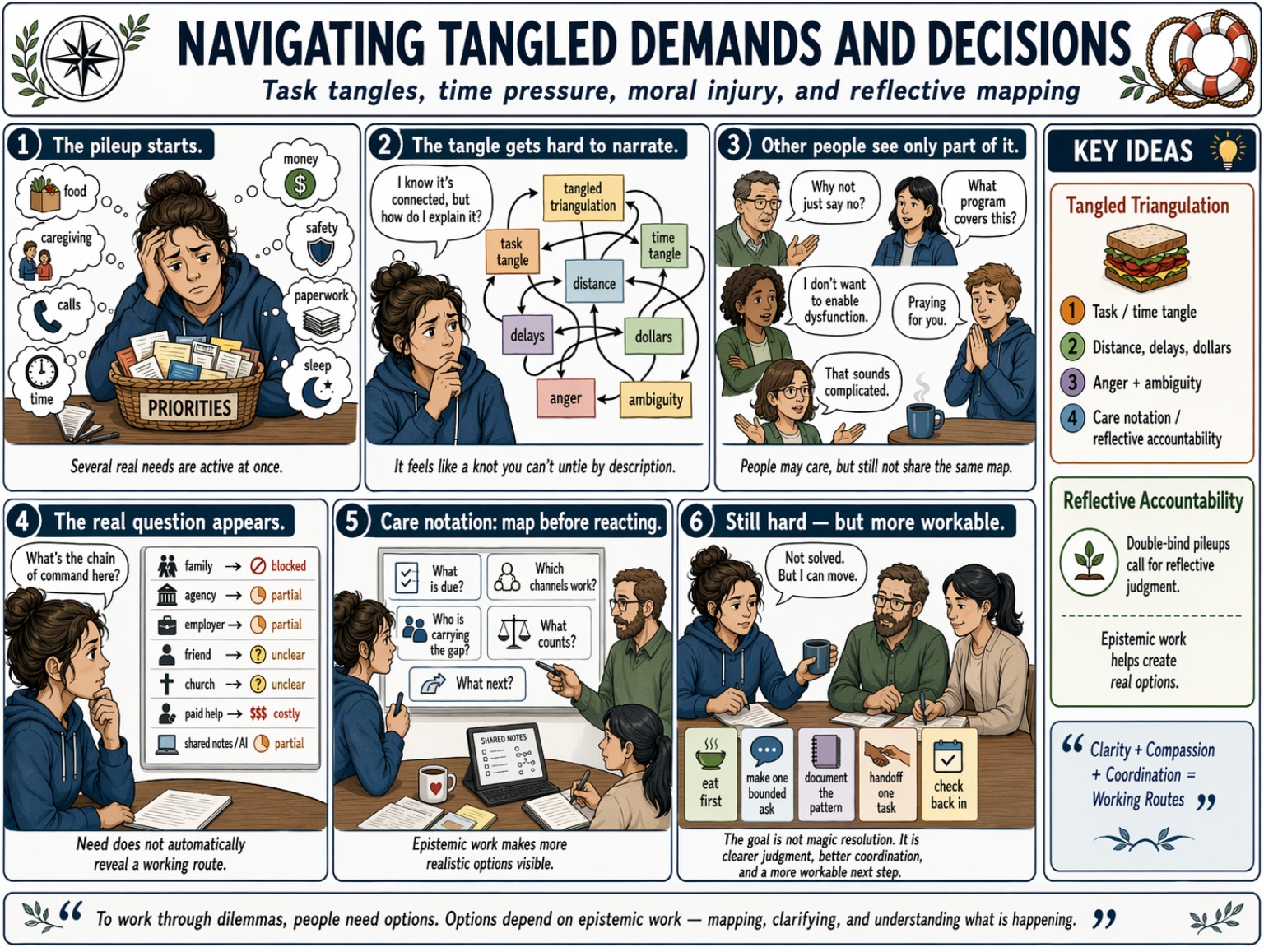
The comic follows overlapping needs, the difficulty of explaining them, and responses based on only part of the picture. A list of possible helpers becomes useful when someone can actually respond under workable conditions.
Read it against one collision: Which need cannot wait? Which route for help is functioning? Who is carrying the uncovered work? What can someone knowingly agree to do next?
A clearer map may reveal an opening or confirm a shortage. Keep that result visible, including differences in power and any protection or additional resources the next move requires.
1. Establish the live needs and consequences
What must happen, for whom, and by when? What happens if it does not? Which timing claims are verified, estimated, disputed, or unknown?
Name the concern in terms the affected person can correct. Keep a request distinct from the need it is intended to meet. There may be several ways to meet a need; there may also be a genuine shortage.
2. Make the collision and capacity visible
Which activities cannot happen together? What time, space, money, attention, skills, access, or permission do they require?
Include the labor of explaining, arranging, checking, and following up. Do not silently assign that work to the person who is already carrying it. Identify decision authority and whose options are constrained.
Acknowledge the impact of what has gone wrong. Acknowledgment need not settle every causal claim before the next practical decision.
3. Propose an arrangement people can knowingly accept
Try a changed sequence, a narrower contribution, separate times or spaces, a different role, an additional resource, or an introduction to someone who could help.
State the proposed scope, conditions, duration, and review point. Ask what is acceptable and what makes it unworkable. Silence, exhaustion, or someone else’s promise is not acceptance.
If cooperation on the whole situation is unavailable, a bounded agreement on one task may still be possible. Separate contributions, an agreed record, or an intermediary may be more workable than direct discussion. If sharing information would expose someone to retaliation, the format and audience need to change.
4. Check the outcome and reduce recurrence
What was actually done? Did the need become met? What cost was shifted to someone else? What remains unresolved?
Then ask what would make the next collision less likely: earlier notice, a buffer, better access, additional help, paid capacity, changed conduct, clearer authority, or a supported transition. This is the generative-accountability part of the work.
If every option leaves a serious gap, record that result. Identify the resource, authority, protection, or new participant that could change it. A conversation should not end by relabeling an unsolved shortage as an individual’s duty to do the impossible.
A compact record
Need and time:
Consequence of delay and uncertainty:
Collision or missing dependency:
Proposed contribution and conditions:
Explicitly accepted by:
Outcome and remaining gap:
Change needed before next time:
Use only the fields needed for the next decision. A short spoken or written exchange may be enough.
A prompt to use with an AI
Help me work through one live collision in a situation involving several people. Start with a brief account of what I have told you; ask only the next question that could change the immediate decision.
Identify needs, consequences of delay, deadlines and uncertainty, available capacity, decision power, and dependencies. Keep observed facts, attributed reports, interpretations, requests, proposals, and accepted commitments distinct.
Do not assume everyone is acting in bad faith or good faith. Preserve evidence of harm and unequal power. Do not assume leaving, direct discussion, reconciliation, or continued unpaid labor is feasible or required.
Help me propose a small workable arrangement: who could do what, with what resources and acceptance, for how long, with what review or alternative. Do not invent anyone’s consent or present an unverified referral as available help.
After the immediate issue, examine impact, responsibility, repair, and changes that would reduce recurrence. Keep unmet needs visible. If there is no feasible arrangement, name the missing resource or authority instead of repeatedly restating the same advice.
Keep the audience in view. Do not assume that a working account, private detail, or someone else’s words can be circulated more widely. Help me identify what is needed for this conversation and what could be separately considered for sharing.
Make the result short enough for the capacity and time I actually have.
Related: Methods & Tools; Generative Accountability; Conscience Pressure; A household under pressure.

