Methods & Tools
Start with the smallest piece of coordination that could materially improve the situation. Add detail when it changes a decision.
At the crossroads
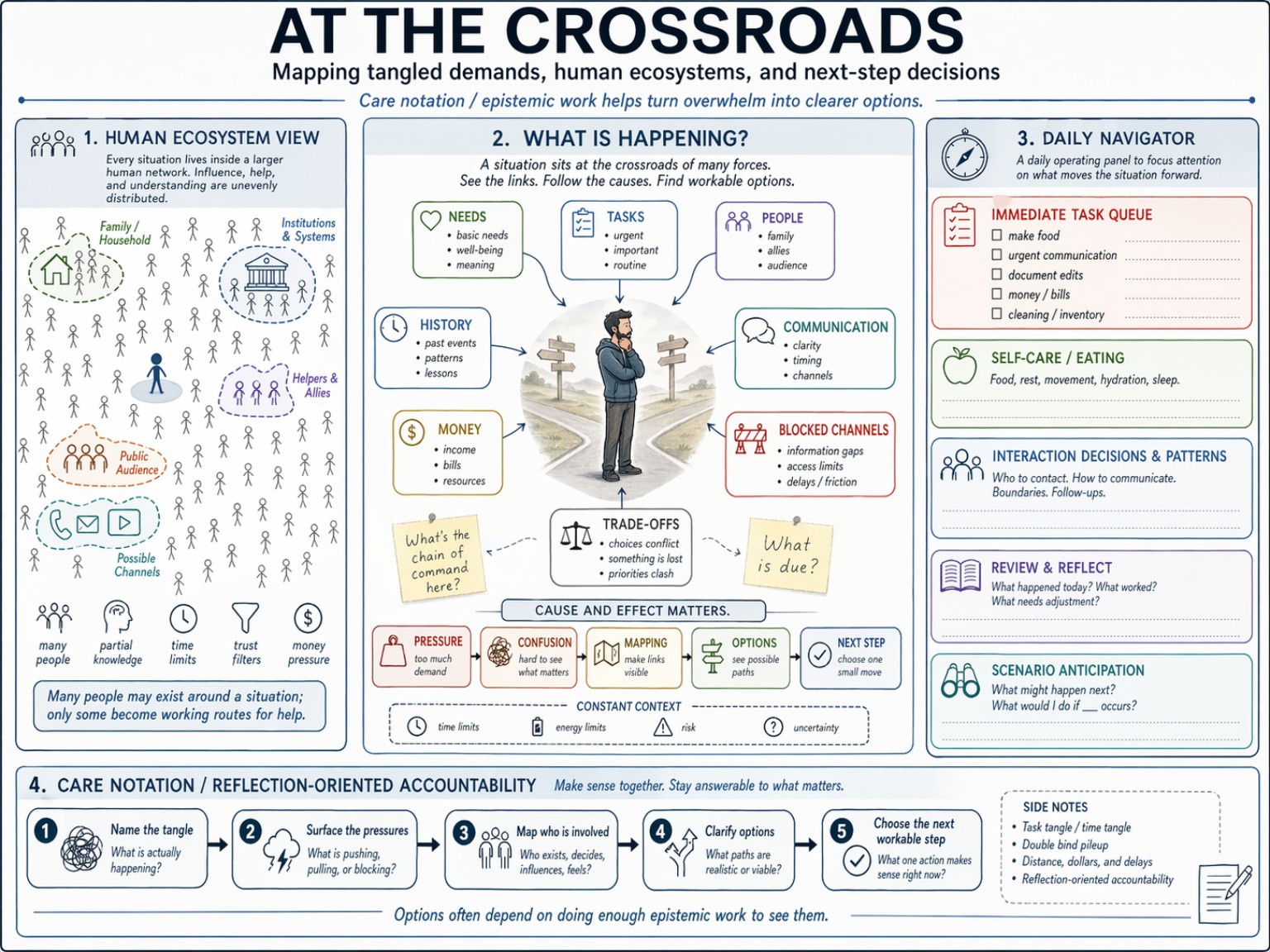
A situation can involve needs, tasks, money, history, relationships, and blocked routes for help at the same time. Use this board to notice a connection that could change the next decision.
Start with one row: What is needed now? Who can contribute or decide? What condition makes that contribution usable? When will we check what happened?
The board asks about a chain of command. Check whether one exists: in a household or informal network, decision authority may be divided or still need to be negotiated. Use only the parts of the board that help with the current question.
Needs coordination
Identify the unmet need, the person’s priorities, the consequences of delay, and when those consequences might occur. Mark uncertainty about timing. Check what makes a contribution usable: compatibility, access, time, skills, money, permission, equipment, and coordination labor.
Keep the sequence visible: needed → offered → checked for fit → accepted → delivered → outcome reviewed. An offer may expire or prove unusable. Completing a task may still leave the need unmet.
Look for unmatched capacities as well as shortages. Someone seeking paid work, direction, or a way to contribute may be part of a workable arrangement if its fit and conditions are established.
Check the livelihood layer: how much is available, when it arrives, how reliable it is, and what earning or accessing it requires. Compare that with essential recurring costs and immediate needs. Record what remains uncovered during a pending process. A new resource may also create a difficult choice among overdue needs; make that tradeoff and its consequences inspectable.
Deconfliction
Identify actions or demands that cannot currently coexist. The collision may concern time, space, money, attention, access, priorities, or decision authority.
Name each request’s purpose and who bears the cost of delay. Explore sequencing, separate spaces or times, a narrower contribution, another resource, a changed role, or a different decision process. Keep any remaining shortfall visible.
Record a provisional arrangement and what requires renewed discussion. Coordination can proceed on one issue while other disagreements remain open.
Negotiating a workable arrangement
Put relevant needs, limits, alternatives, and proposed terms where affected people can inspect them. The method should remain usable when everyone understands it.
Ask what each person can actually undertake, what support makes that possible, who can decide, who can decline, and who is affected without having been included.
A proposal names scope, resources, timing, a check-in, and how it can be changed or ended. Track explicit acceptance. A limit may require a revised plan; it need not become a character verdict. A refusal also does not make the unmet need disappear.
Write it down together
Use a short note, voice summary, drawing, or accessible shared format. Separate observations, attributed accounts, interpretations, and open questions. An absent person’s agreement cannot be inferred.
The record supports inquiry and follow-through. It should not turn one participant’s interpretation into an unquestionable scorecard.
Choose and negotiate the audience
A useful working conversation may involve only a few people. Broader learning can grow from selected questions, demonstrations, or accounts that people choose to share.
Working space: Individual notes
Who it is for: The person developing an account or question
What it can hold: Unfinished thinking and material not yet selected for others
Working space: Situation working group
Who it is for: Selected participants and helpers
What it can hold: Details needed for a particular piece of coordination
Working space: Invited workshop
Who it is for: A bounded audience gathered around a question
What it can hold: Agreed excerpts, different accounts, method trials, and possible public material
Working space: Public piece
Who it is for: A wider intended audience
What it can hold: A chosen account, explanation, illustration, lesson, or invitation
These are options, not stages everyone must pass through. Someone may want a named public contribution while keeping other parts of their circumstances within a smaller group.
Before circulating shared project material, record what is being shared, with whom, for what purpose, with what attribution or omissions, and what further reuse is agreed. Check details involving people who are not participating. Review the actual proposed excerpt or account; permission for a workshop does not imply permission to publish it.
When accounts or sharing preferences differ, preserve the disagreement. Consider separate attributed accounts, a narrower excerpt, an illustrative example, or a different audience. No one person’s account should be presented as a collective conclusion without agreement. These arrangements govern shared project material; they do not settle every question about someone speaking independently about their own experience.
Agree on correction and review arrangements. Public material may be copied, so later editing cannot guarantee that every copy disappears. A workshop need not be recorded, and a public lesson need not disclose the whole situation.
Worked entry points
When needs collide combines these practices with generative accountability and includes a short AI conversation prompt.
When how to help is a mystery turns a question nobody can answer yet into an inquiry, with a shared board for who is involved, who knows what, and what is blocked.

