Whole Story Assembly
Concept · Working definition · Revised 24 September 2026
Whole Story Assembly is the ongoing, collective work of bringing together enough relevant history, perspectives, conditions, and possibilities to understand a situation and respond to it more intelligently.
The picture stays revisable. No person has to know everything, and action need not wait for a complete or unanimously accepted account.
Why it helps
People often enter a situation through different doors: a missed task, a reported harm, an unmet need, an institutional rule, a promising opportunity. Each can reveal something consequential. Connecting them may change what an event means, what someone can reasonably undertake, or which response is feasible.
The work includes the past, present, and possible future: how people arrived here; what is happening now; what they hope to preserve or change; and what different next moves would require.
Why communication stalls
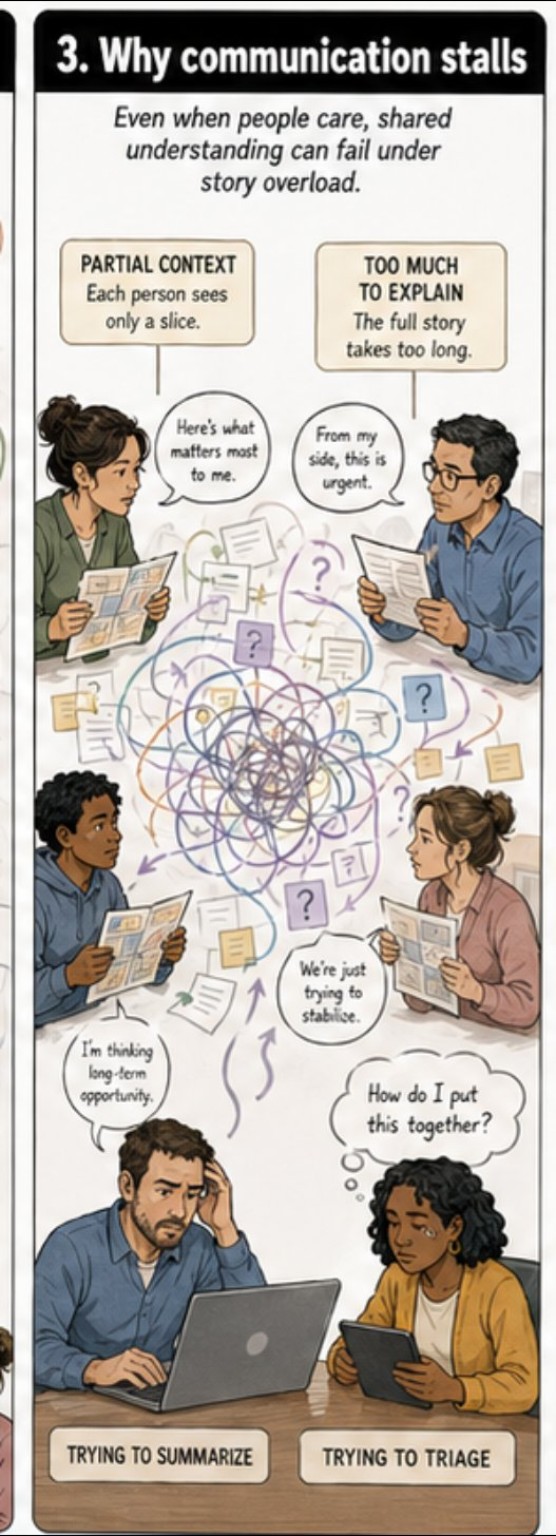
People may be discussing the same situation while trying to answer different questions. One is focused on urgency, another on long-term possibilities, another on getting through today. Explaining how those concerns connect takes time and attention.
Make a small shared starting point: Name the decision in front of you, give the context that could change it, and mark what remains disputed or missing. Invite a correction before expanding the account.
A summary should help people locate their concern. It need not produce a single agreed story. Preserve different accounts and check whether assembling them changes the available options.
What to assemble
- Accounts and evidence: What was observed, who reports what, and where accounts diverge.
- Time and trajectory: Relevant history, recent changes, deadlines, and emerging possibilities.
- People and power: Needs, skills, roles, dependencies, decision rights, and who bears the consequences.
- Conditions: Money, time, space, health, access, institutional limits, and wider changes.
- Attempts and possibilities: What has been tried, what happened, and which alternatives are available, conditional, unexplored, or blocked.
A small starting move
Choose one consequential question. Write a short account of what is known and what is disputed. Invite corrections where feasible. Identify one action that can proceed, its dependencies, and a time to review the result.
For example: “Three necessary tasks overlap this afternoon. What must happen first, what capacity exists, and what help would change the feasible sequence?” A shared note can connect each request to its purpose and constraints, then make a provisional arrangement visible.
Distinctions to preserve
Understanding context does not by itself settle responsibility. Recognizing pressure on several people does not establish that their power, conduct, or obligations are equivalent. An explanation needs to remain connected to the specific concern it is answering.
Participation may be uneven or constrained. Missing perspectives should remain visible as gaps; the map should not invent someone’s motives or claim their agreement. Some information requires a restricted audience, and some work can proceed through separate contributions.
Signs that the map is becoming useful
Someone corrects an assumption. A request becomes clearer. A previously invisible dependency is recognized. An offered resource becomes usable. A decision changes. People can carry the next step into another conversation with less rebuilding.
Keep a record of those changes, including failures and unexpected costs. A larger map is useful only insofar as it improves understanding or action.
Related: Generative Accountability; Working the Problem Under Conscience Pressure; When needs collide; Methods & Tools; A household under pressure; Open Questions.

