Working the Problem Under Conscience Pressure
Concept and practice · Adapted from the existing essay of the same name
Conscience pressure names the intensity and weight of trying to respond responsibly when visible needs, interpretive complexity, and failing response systems exceed ordinary capacity.
It combines strain with an active figuring-out process: making sense of what is happening, deciding where to direct attention, and searching for a response when familiar scripts or referrals do not produce coordination.
It can circulate among people as real needs and unclear response paths place more burden on human time, judgment, and attention.
Where does the pressure go?
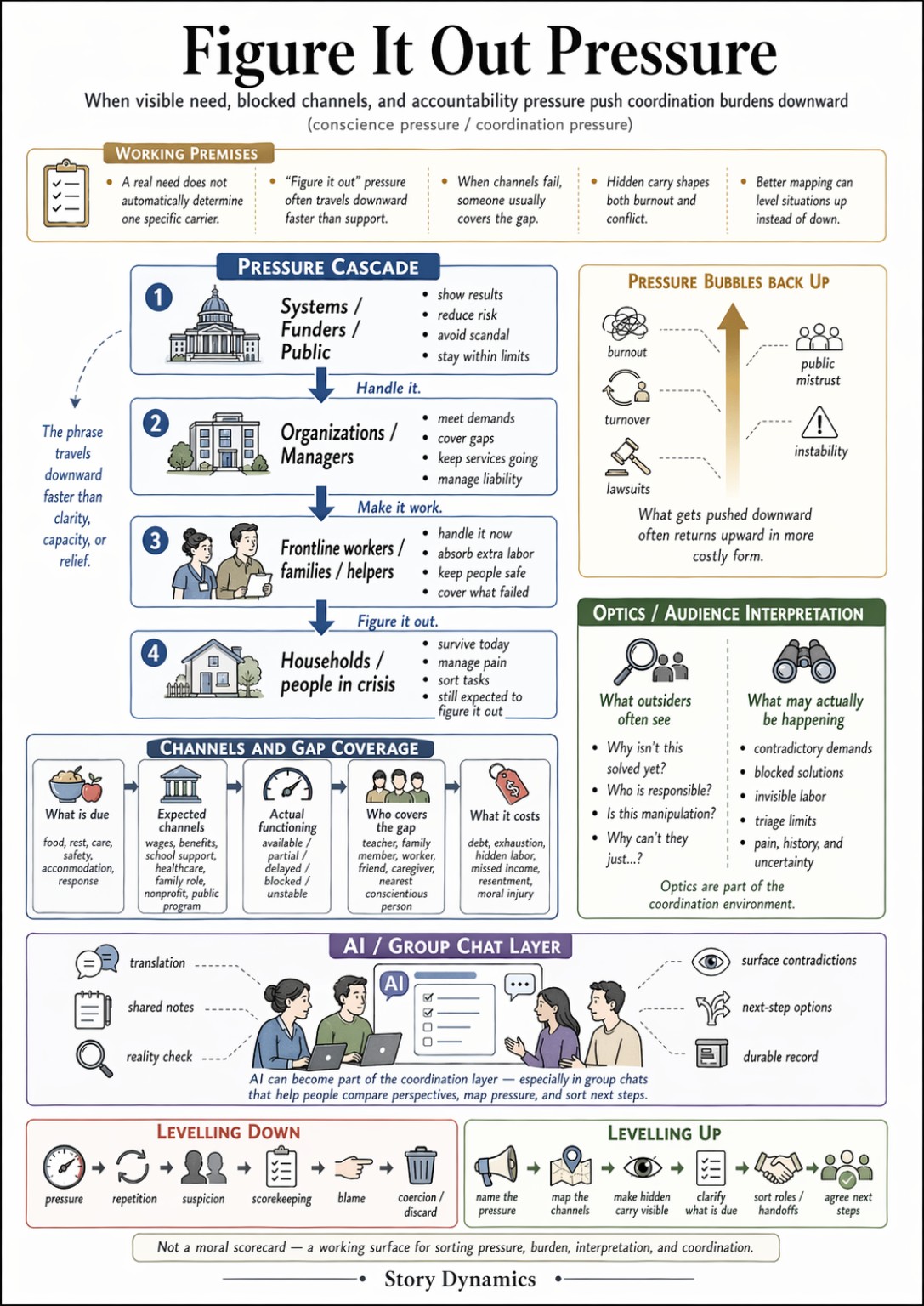
This board follows a possible pattern: demands move through institutions, organizations, frontline roles, and households while support fails to arrive. In a particular situation, those roles may overlap and pressure may travel in several directions.
Follow one unmet need: What is due? Which channel is expected to respond? What is that channel actually providing? Who covers the gap, and at what cost?
Then ask what would change the arrangement: usable resources, an accepted role, an introduction, or a decision from someone with the relevant authority. Making hidden work visible is a starting point; the work still needs capacity.
Where it appears
Sometimes the pressure concerns an essential need or a fragile arrangement. Sometimes it concerns finding a livelihood, using one’s abilities, or helping someone whose circumstances do not fit the available roles. Often several such situations overlap.
The relevant question is what makes life workable in these circumstances. An extraordinary event is not required for ordinary life to contain serious stakes.
Recognition and coordination
A problem can be acknowledged while its practical conditions remain unchanged. A resource can exist without becoming accessible. A helpful conversation can end without an accepted or feasible next step.
Conscience pressure accumulates in that gap. Repeatedly rebuilding an explanation can add further work without improving the available options.
Four checks
Reality: What is actually happening now? What is known, disputed, changing, or time-sensitive?
Role: What am I able and responsible to do? What needs another person’s capacity, an introduction, different authority, or a revised arrangement?
Response: What contribution fits now: acknowledgment, verification, a concrete request, partial engagement, deeper work, a pause, or escalation? What effects might it have?
Coordination: Does this move help meet a need or improve the arrangement? Does it shift work onto someone who has not agreed or cannot carry it? What remains uncovered?
Needs and unmatched capacities
The coordination gap also includes people looking for meaningful work, direction, and a way to contribute. Connecting needs with compatible capacities may help both, if the work has a feasible scope, resources, and accepted terms.
Naming the pressure creates a starting point for discernment. The next question is what piece of coordination could change the circumstances, and what support is required to do it.
Development source: Working the Problem Under Conscience Pressure, existing three-page essay. This shorter adaptation keeps its recognition/coordination distinction and four checks; it does not replace the original essay.

